Unify your data for real-world AI applications — without the downtime. Discover the 5-phase roadmap BTG uses to help organizations modernize their infrastructure on Microsoft Azure.
The 5-Phase Roadmap to Modernize Your Infrastructure on Microsoft Azure
Unify your data for real-world AI applications — without the downtime.
Our latest blog reveals the 5-phase roadmap Boomer Technology Group uses to help organizations modernize their infrastructure on Microsoft Azure and unify their data for real-world AI applications — without the downtime. Here's what we cover:
Phase 1: Assessing Your Current Data Estate
Every modernization effort starts with clarity. We inventory your existing systems, applications, and data sources to understand where your data lives, how it flows, and where the hidden risks and inefficiencies are hiding before a single workload moves to the cloud.
Phase 2: Unifying OT and IT Data Silos
Operational technology and information technology have lived in separate worlds for too long. We bridge the gap between plant-floor systems and enterprise IT so machine data, sensor data, and business data can finally work together.
Phase 3: Building a Secure Cloud Foundation on Azure
With a clear picture of your data estate, we architect a secure, scalable foundation on Microsoft Azure — built on Microsoft's enterprise-grade security, identity, and governance capabilities from day one, not bolted on afterward.
Phase 4: Implementing Pilot AI-Driven Workflows
Rather than a risky, all-at-once rollout, we launch targeted AI-driven pilot workflows that prove value quickly, build internal confidence, and generate the real-world lessons needed to scale successfully.
Phase 5: Scaling for Enterprise-Wide ROI
Once the pilots prove out, we help you scale those workflows enterprise-wide — turning a modernized data estate and Azure foundation into measurable, compounding return on investment.
Stop letting 20-year-old software dictate your future growth. It's time to turn your infrastructure into a competitive advantage.
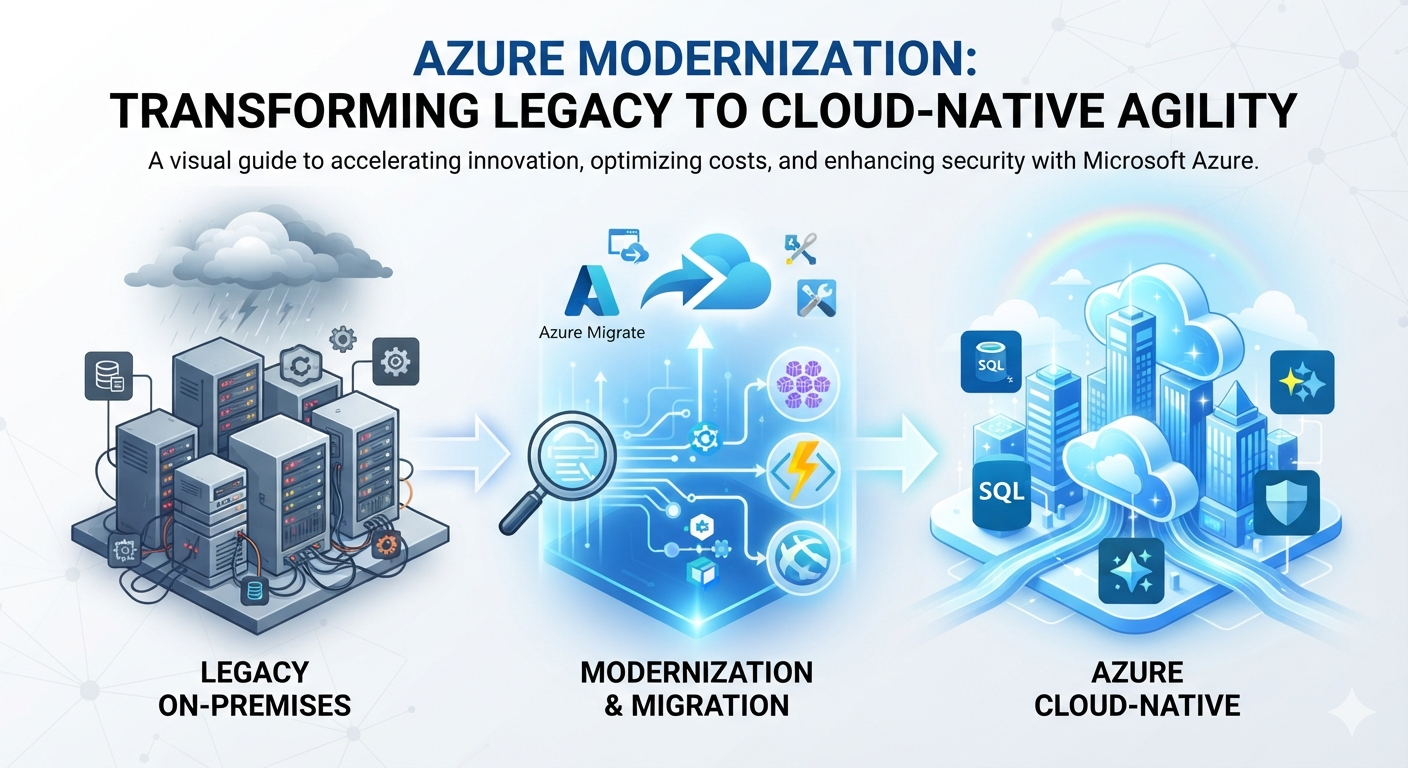
A visual guide to accelerating innovation, optimizing costs, and enhancing security with Microsoft Azure.
---# The Detailed 5-Phase Azure Migration Roadmap
Phase 1: Discover and Assess
Objective: Establish a fact-based view of the current technology environment.
Activities
- Inventory servers, applications, databases, integrations, and dependencies.
- Identify workloads running on Windows, Linux, VMware, SQL Server, Oracle, PostgreSQL, .NET, and Java.
- Classify workloads by business criticality, technical condition, compliance requirements, and migration complexity.
- Document performance, utilization, licensing, security, and support constraints.
- Identify workloads that should be retired, rehosted, replatformed, refactored, or retained.
Azure Capabilities
- Azure Migrate
- Azure Copilot migration agent
- Azure Migrate discovery and assessment tools
- Azure dependency analysis
BTG Deliverables
- Current-state technology inventory
- Application and infrastructure dependency map
- Workload assessment
- Risk register
- Preliminary cost and licensing analysis
- Migration candidate list
Decision gate: No workload moves forward without an approved assessment, owner, target state, and business justification.
Phase 2: Strategy and Target-State Planning
Objective: Define what the organization will move, why it will move, and how success will be measured.
Activities
- Establish business, technical, security, and financial objectives.
- Define the target Azure architecture.
- Select the appropriate migration pattern:
- Retire: Remove obsolete workloads.
- Retain: Keep workloads where migration is not justified.
- Rehost: Move with minimal modification.
- Replatform: Move to a managed Azure service with limited redesign.
- Refactor: Redesign the application for cloud-native operation.
- Establish workload sequencing and migration waves.
- Define recovery time objectives and recovery point objectives.
- Create a communications and change-management plan.
Azure Service Considerations
- Azure Virtual Machines
- Azure App Service
- Azure Kubernetes Service
- Azure SQL
- Azure Database for PostgreSQL
- Azure VMware Solution
- Azure Arc
- Oracle Database@Azure
BTG Deliverables
- Azure migration strategy
- Target-state architecture
- Migration-wave plan
- Business case
- Budget model
- Success metrics
Decision gate: Leadership approves the business case, target architecture, migration sequence, and funding model.
Phase 3: Prepare the Azure Foundation
Objective: Build a secure, governed, and repeatable Azure environment before production migration begins.
Activities
- Establish the Azure tenant and subscription structure.
- Design resource groups, management groups, naming standards, tagging, and policies.
- Configure identity, role-based access control, network connectivity, logging, and monitoring.
- Define security baselines and compliance controls.
- Establish landing zones for production, development, testing, and disaster recovery.
- Create standardized deployment templates and approval processes.
- Train internal teams on operational responsibilities.
Azure Capabilities
- Azure landing zones
- Azure Arc
- Microsoft Defender for Cloud
- Azure Monitor
- Azure Policy
- Azure Update Manager
- Azure Cost Management
BTG Deliverables
- Azure landing-zone design
- Security and governance baseline
- Identity and access model
- Network and connectivity design
- Operational readiness checklist
- Deployment standards
Decision gate: The environment must pass security, governance, connectivity, monitoring, and recovery-readiness reviews.
Phase 4: Migrate, Modernize, and Validate
Objective: Move workloads in controlled waves while reducing business disruption.
Activities
- Begin with a pilot workload that is representative but manageable.
- Validate migration procedures before expanding the wave.
- Move or modernize applications, databases, and infrastructure.
- Perform data validation and integration testing.
- Conduct performance, security, backup, disaster recovery, and user acceptance testing.
- Use automated recommendations to right-size infrastructure and select IaaS or PaaS targets.
- Use GitHub Copilot modernization capabilities for supported application upgrades, including .NET and Java workloads.
- Document rollback procedures and cutover responsibilities.
- Execute production cutover only after acceptance criteria are met.
Azure Capabilities
- Azure Migrate
- Azure Database Migration Service
- Azure App Service
- Azure Kubernetes Service
- Azure SQL
- Azure Database for PostgreSQL
- GitHub Copilot modernization
- Azure Copilot migration agent
BTG Deliverables
- Wave execution plan + test scripts and results
- Data reconciliation report
- Cutover plan
- Rollback plan
- User acceptance sign-off
- Updated technical documentation
Decision gate: Each wave requires documented test results, business approval, operational ownership, and a validated rollback option.
Phase 5: Operate, Optimize, and Improve
Objective: Ensure the Azure environment produces measurable business value after migration.
Activities
- Monitor availability, performance, security events, and service health.
- Right-size workloads and remove unused resources.
- Review licensing and consumption regularly.
- Automate routine remediation and operational tasks.
- Apply patches and maintain supported operating-system versions.
- Review application performance and technical debt.
- Measure business outcomes against the original business case.
- Establish a continuous-improvement backlog.
- Evaluate opportunities for data modernization, AI agents, predictive analytics, and process automation.
Azure Capabilities
- Azure Monitor
- Microsoft Defender for Cloud
- Azure Cost Management
- Azure Update Manager
- Azure Automation
- Azure Arc
- Azure Copilot
- Azure SQL and managed database services
BTG Deliverables
- Monthly operational scorecard
- Security and compliance review
- Cost-optimization report
- Performance report
- Technical-debt register
- Continuous-improvement roadmap
- Executive outcome review
Decision gate: The migration is not complete at go-live. It is complete when the environment is stable, measurable, secure, supportable, and delivering the expected business outcomes.
Boomer Technology Group — Microsoft Partner | www.btgsi.com | 732-800-2058 | derrisboomer@btgsi.com